How Large Language Models Actually Work: A Beginner-Friendly Guide
Curious how ChatGPT and other AI chatbots actually work? This beginner-friendly guide explains how large language models are built and why they hallucinate.
Advertisement
You have probably chatted with an AI assistant by now — asked it to summarize a document, draft an email, or explain a confusing concept. These systems can feel almost human in conversation, which makes it easy to imagine there is a mind behind the curtain. There isn't. What is actually running is something stranger and, in its own way, more impressive: a giant statistical machine that has become remarkably good at predicting text.
This guide walks through how large language models work in plain language, no math degree required. By the end, you will know what happens between the moment you type a question and the moment an answer appears — and why these systems are brilliant at some tasks while confidently failing at others.
What Is a Large Language Model?
At its core, a large language model (LLM) is a neural network trained to do one thing: predict the next word in a sequence of text. That single objective, applied at enormous scale, is what produces everything else — answering questions, writing code, translating languages, composing poetry.
The "large" in the name refers to several things at once:
- Parameters. These are the adjustable internal values the model tunes during training. Modern LLMs contain billions of them.
- Data. Training corpora can span trillions of words drawn from books, websites, code repositories, and other sources.
- Compute. Training a frontier model typically requires thousands of specialized GPUs running for weeks or months.
When you ask ChatGPT, Claude, or Gemini a question, the model isn't searching a database for the answer. It is generating a response one small piece at a time, drawing on patterns absorbed during training.
It All Starts With Tokens
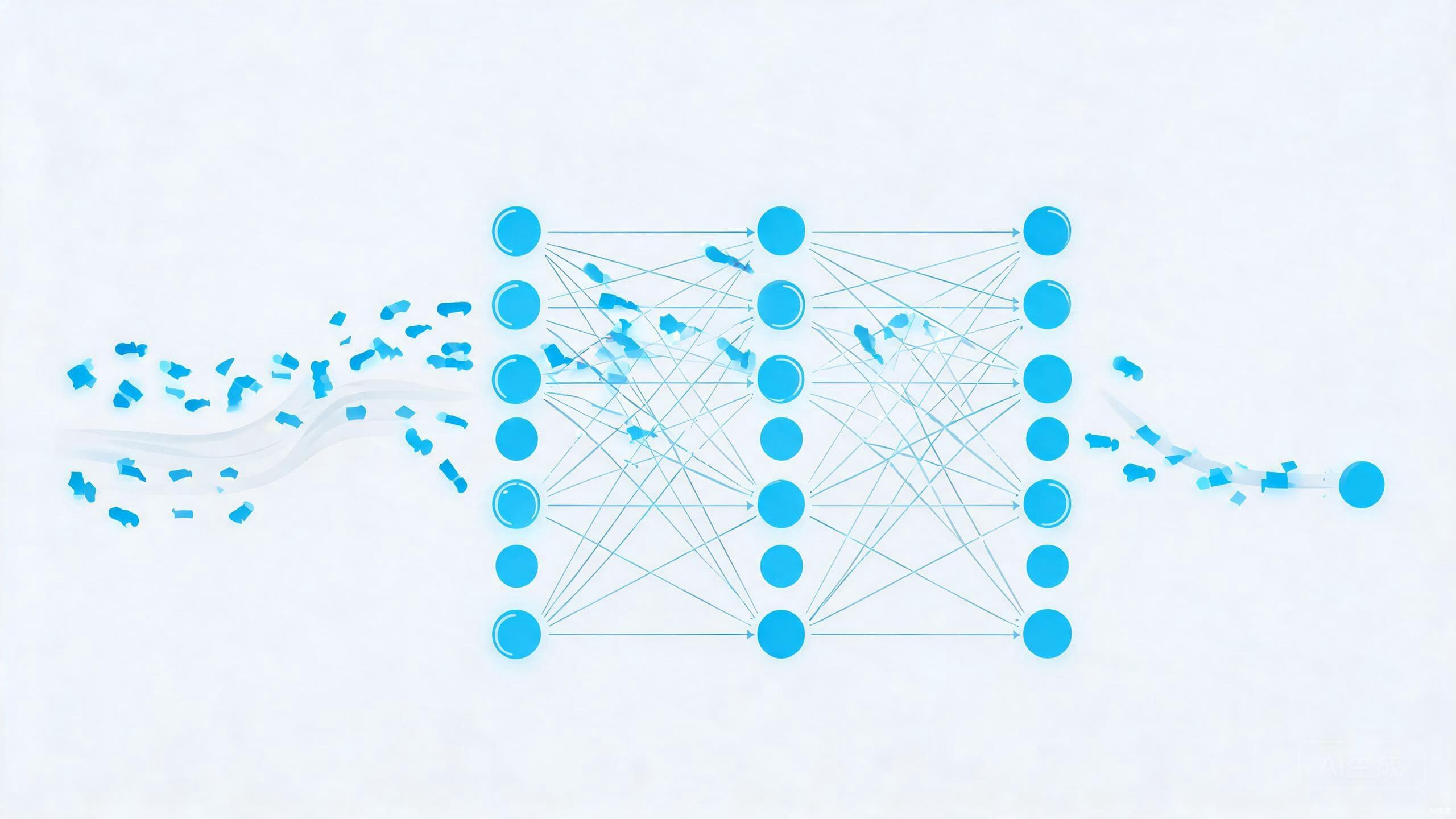
Before a model can process text, the text is broken into chunks called tokens. A token might be a whole word, part of a word, a punctuation mark, or a space attached to a few characters. A longer word like "unbelievable" might split into pieces such as "un", "believ", and "able", while common words like "the" usually occupy a single token.
Tokenization explains some famously odd LLM behavior. Ask a model how many times the letter "r" appears in "strawberry" and it may falter — not because it is careless, but because it never sees individual letters. It sees token IDs. Tokenization also affects cost and speed, since most services bill by the token, and it is part of why the same sentence can consume more tokens in some languages than in English.
Each token is converted into a list of numbers called an embedding, which captures something about its meaning. Words with related meanings end up with similar embeddings, so "king" and "queen" sit closer together in this mathematical space than "king" and "refrigerator".
How the Model Learns
Training a large language model happens in stages.
Pretraining. The model reads enormous amounts of text and repeatedly guesses the next token. Every wrong guess nudges its billions of parameters slightly toward better predictions. After trillions of these corrections, the model develops a surprisingly deep grasp of grammar, facts, style, and reasoning patterns — not because anyone taught those things explicitly, but because they are woven through the text it studied.
Fine-tuning. A raw pretrained model is a talented but unruly text-completion engine. Ask it a question and it might simply continue with more questions. Fine-tuning on curated examples teaches it to behave like a helpful assistant — following instructions, staying on topic, and declining harmful requests.
Alignment. Finally, techniques such as reinforcement learning from human feedback (RLHF) use human reviewers to rank candidate responses, and the model is adjusted to prefer the ones people actually like. This stage is a big part of why modern assistants feel focused and cooperative rather than rambling.
The Transformer: The Engine Behind It All
Nearly every modern LLM is built on an architecture called the transformer, which a landmark 2017 research paper introduced under the title "Attention Is All You Need". Its defining idea is a mechanism called self-attention.
Self-attention lets the model weigh how strongly every token relates to every other token in the input. In the sentence "The cat sat on the mat because it was tired", attention helps the model resolve that "it" refers to the cat, not the mat. These relationships are computed across dozens of stacked layers, each building a more abstract understanding of the text — basic syntax near the bottom, nuance and intent near the top.
Transformers also process all tokens in parallel rather than strictly one at a time, which is what made training on internet-scale datasets practical in the first place. Without that architectural breakthrough, today's chatbots would not exist in anything like their current form.
Why Do LLMs Hallucinate?
Hallucination — stating false things with complete confidence — is not a bug somebody forgot to fix. It is a natural side effect of how these systems work.
An LLM is optimized to produce plausible text, not verified truth. When you ask about a topic where its training data is thin, it will often generate something that sounds right rather than admitting ignorance. It can invent citations, blend two similar people into one fictional hybrid, or misremember dates with total serenity.
A few habits reduce the risk:
- Ask the model to reason step by step instead of jumping straight to an answer.
- Verify anything load-bearing — statistics, quotes, citations, medical or legal claims — against real sources.
- Provide source material in the prompt, so the model summarizes what is in front of it rather than recalling from memory.
Where LLMs Go From Here
The models keep improving, but the frontier has shifted. Labs now train reasoning models that work through problems longer before answering, multimodal models that handle images and audio alongside text, and smaller models efficient enough to run on phones and laptops — a trend we cover in our explainer on on-device AI.
Day-to-day quality also depends heavily on how you communicate with these systems. Learning to ask well is a genuine skill, and it is one you can build with our guide to prompt engineering basics. Developers face an even bigger decision, as our article on choosing an AI coding assistant lays out.
Conclusion
Large language models are prediction engines scaled up until prediction starts to look like understanding. They don't look things up, they don't fact-check themselves, and they have no inherent concept of truth — only likelihood. That combination makes them extraordinary drafting partners, brainstormers, and explainers, and unreliable as sole authorities on facts.
Understanding the mechanics strips away both the magic and the menace. Once you see an LLM as a very well-read pattern machine, you are in a far better position to use it for what it does well — and to catch it when it drifts into fiction.